



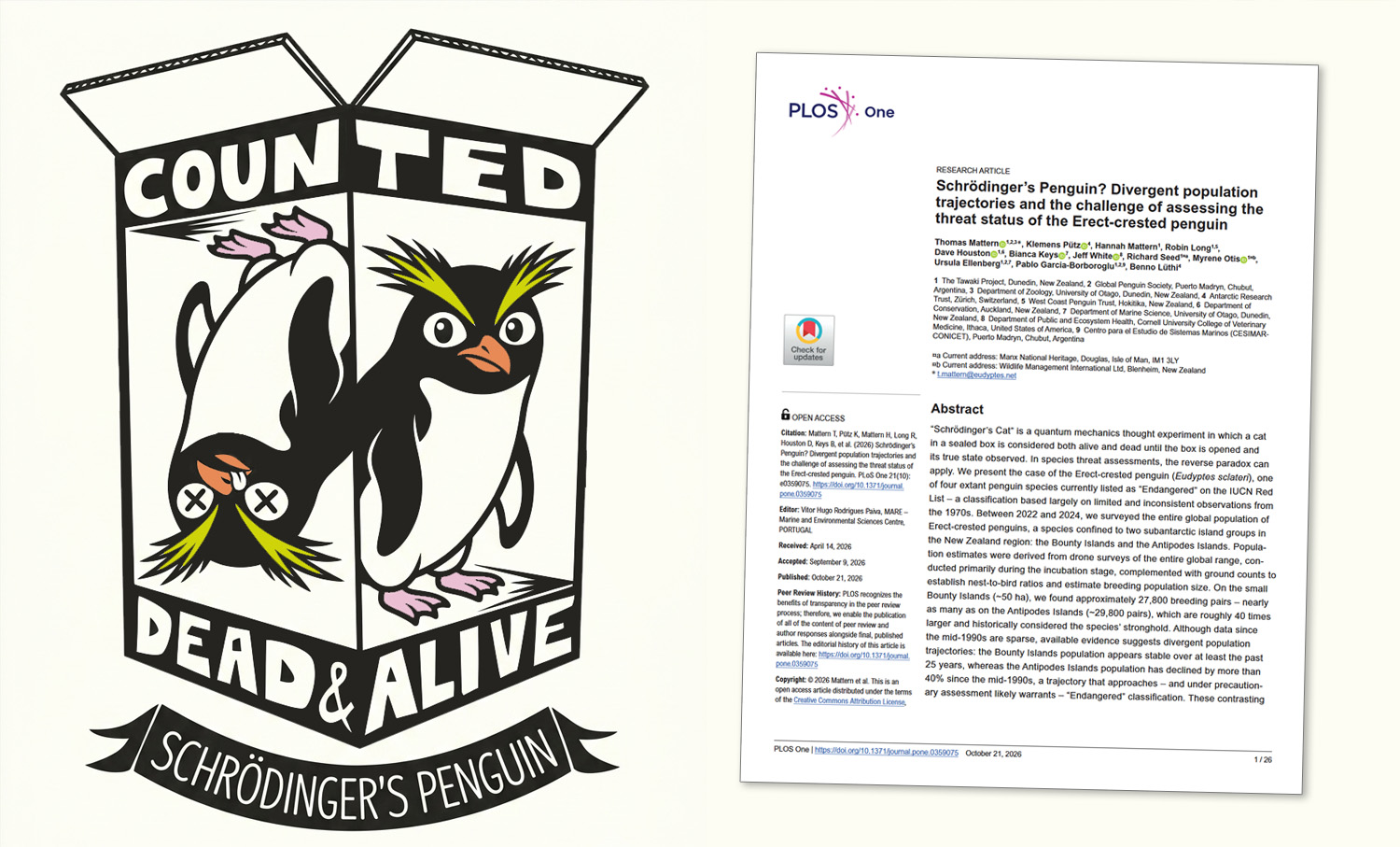
Schrödinger’s Penguin is out!
The first complete census of the Erect-crested penguin reveals two populations on opposite trajectories – and a problem for how the species’ threat status is assessed.
The Erect-crested penguin (Eudyptes sclateri) is one of the world’s least known penguins. It breeds only on two remote subantarctic island groups south-east of New Zealand, the Bounty Islands and the Antipodes Islands, and is currently listed as “Endangered” on the IUCN Red List. That listing rests largely on limited and inconsistent observations from the 1970s.
Our new study, published in PLOS One, changes that. Between 2022 and 2024, The Tawaki Project and its partners surveyed the species’ entire global range. Drones mapped every breeding colony, and ground counts of nests on selected sites allowed us to convert bird counts into estimates of breeding pairs. It is the first reliable full census of the species.
Two islands, two stories
On the Bounty Islands, a cluster of bare granite outcrops covering only about 50 hectares, we found around 27,800 breeding pairs. That is nearly as many as on the Antipodes Islands (~29,800 pairs), which are roughly 40 times larger and have historically been regarded as the species’ stronghold.
The trends are just as different. The Bounty Islands population appears stable over at least the past 25 years. On the Antipodes, the population has declined by around 43% since the mid-1990s.
The reasons likely lie in the differences between the two sites. Bounty Islands penguins may have access to more productive subtropical waters during the non-breeding season. On the Antipodes, colonies are fragmenting, and predation by Subantarctic skuas on smaller, less dense groups feeds a self-reinforcing decline. Historically, skuas there could rely on large numbers of Eastern Rockhopper penguins, but that species has collapsed across the region, leaving Erect-crested penguins to bear the pressure. Skuas are entirely absent from the Bounty Islands.
Why “Schrödinger’s Penguin”?
In the famous thought experiment, a cat in a sealed box is considered both alive and dead until the box is opened. For the Erect-crested penguin, the opposite happened: opening the box showed that both states are real at once. The species is stable in one place and declining towards extinction in another.
That creates a conundrum for threat assessment. IUCN listings are made at the global level, and combined, the two populations would likely see the species downgraded to “Vulnerable”. The Antipodes decline would disappear into the average. Worse, a downlisting could be misconstrued as a reason to ease scrutiny of fisheries around the Bounty Islands – which may now be the species’ last stable stronghold.
What’s next?
Our next step is to track birds from both island groups with GPS dive loggers and satellite tags during the pre-moult and winter periods, to understand whether differences at sea help explain the populations’ diverging fortunes.
Acknowledgements
This research was funded by the Vontobel Foundation via the Antarctic Research Trust, with support from the Global Penguin Society. We thank the Department of Conservation for permission to work in the Bounty and Antipodes Islands Nature Reserves, and all co-authors and field team members.
The paper
Mattern T, Pütz K, Mattern H, Long R, Houston D, Keys B, White J, Seed R, Otis M, Ellenberg U, Garcia-Borboroglu P, Lüthi B (2026) Schrödinger’s Penguin? Divergent population trajectories and the challenge of assessing the threat status of the Erect-crested penguin. PLOS One 21(10): e0359075. https://doi.org/10.1371/journal.pone.0359075